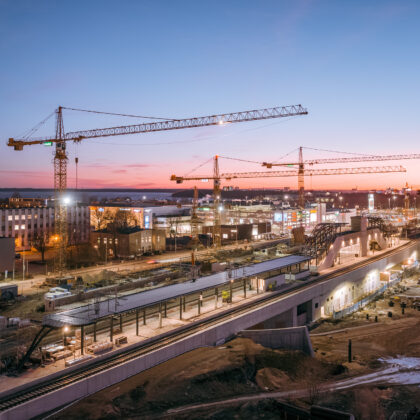
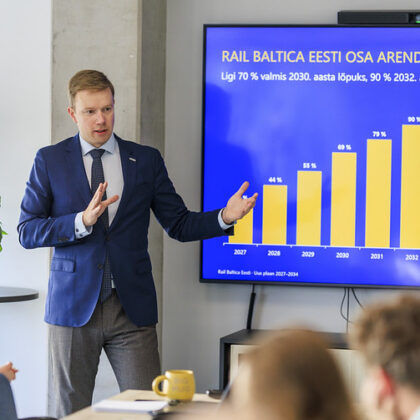
Rail Baltica construction is currently underway for almost 120 kilometers between Tallinn and Pärnu, and contracts have been signed for the entire Estonian section of the railway. Several thousand Estonian and international experts, specialists and workers are working on the construction. The railway will be completed on time, but what happens after that and will we be able to value the experience gained in the long term, asks Anvar Salomets, the head of Rail Baltic Estonia.
One idea, which requires cooperation between the state, the private sector, universities and professional associations, is the creation of a railway cluster, which would more systematically pool the railway capabilities of different parties. The question is whether we will let the experience gained in developing Rail Baltica disperse with the projects after the end of construction or turn it into a permanent capability of Estonian companies. The real impact of a project of the size of Rail Baltica is not and will not be only the new railway. This also includes a circle of companies that will be able to export their knowledge and experience in the future and participate in railway developments in the Nordic countries, Europe and beyond.
The first initiative to bring a railway cluster to life has been initiated, now it is important that we are able to involve the best capabilities of Estonian companies in the entire railway value chain. We already have strong companies operating in the fields of construction, technology, electronics, automation and cybersecurity, but so far they have not been sufficiently looked at in the context of the railway industry. A cluster would not necessarily mean a new organization with a large office and administration. Its value would primarily lie in creating cooperation that would increase the competitiveness and export capacity of local companies and would also give the country, in the wake of Rail Baltica, a favorable reference for attracting foreign investments related to the global railway industry to Estonia. According to a study commissioned by UNIFE, the umbrella organization of the European railway industry, the average annual volume of the sector's value chain in 2021-2023 was over 200 billion euros per year, and a new study to be published in September predicts that the volume will probably be almost 250 billion. Both Estonian companies and the state could participate in this market through foreign investments.
At the same time, in parallel with the construction of tracks, bridges and terminals, we should already be thinking about the longer-term impact of the connection and how we can make the most of the experience gained. Railways cannot be built or maintained with project-based knowledge alone. To do this, we need engineers, designers, builders, system integrators, traffic management and safety experts, and specialists with very different competencies and in-depth experience who know the ins and outs of modern railway technologies. These people cannot be ordered overnight when the need arises, nor can they quickly acquire knowledge in this area from textbooks.
Therefore, in some sense, Rail Baltica should also be considered as a development program for Estonian railway competence. The international alliances working on the project today bring to Estonia knowledge that would normally take decades to acquire. Local companies can participate in the design and construction of complex facilities, learn international project management, and work with European standards and new technological solutions.
Several sections of Rail Baltica require very demanding engineering solutions that are transferable to the construction of infrastructure throughout Central Europe and the Nordic countries. For example, the Soodevahe traffic junction in Harju County, where railway corridors of different widths and a road intersect at three levels, and the solution is affected by high groundwater, complex soil and the need to keep traffic in the area running continuously. Also, complex solutions are required for building a railway in a bog, where it is necessary to use a bog slab supported by piles, the construction of which requires not only knowledge of local conditions and technical acumen, but also extensive knowledge of the specifics of similar projects and world practices.
In other words, the prerequisites for collecting and developing knowledge of railway construction are there, now the question is how to transfer it to the wider economy. Undoubtedly, the ability of companies related to railway construction to retain this knowledge or to supplement the curricula of research institutions is not enough, we need to approach it more systematically.
First, more conscious cooperation between educational institutions, companies, professional associations and the public sector is needed. As has been pointed out by other experts before, our engineering curricula are already being supplemented and have received significantly fresher content in recent years. Another and additional opportunity is to consolidate and develop knowledge through shorter so-called learning sessions and the exchange of international experiences.
We have discussed the idea of creating a summer railway academy with the Rail Baltic Estonia team, which could give today's formal education an additional and international dimension. This does not mean a new educational institution, but a cooperation platform that combines existing technical education, the practical needs of companies and international know-how. It is clear that for today's young people, linking their future with the railway sector does not come naturally - there is enough output and prospects in the sector, but there is no systematic approach that would help young people achieve this through education.
The construction of Rail Baltica also provides an opportunity to use the facilities as a practice base and project-based learning environment. Young engineers will have the opportunity to work with experienced international experts, and company specialists will have the opportunity to improve their knowledge in real projects. This is how know-how is transferred.
Thirdly, I would like to highlight the dimension of regional development and economic impact, which has received little attention so far. With new initiatives and steps, we should not forget to link the railway with local development and entrepreneurship. The new connection will affect investment decisions even before the first train leaves. Not only in Tallinn, but also in Kohila, Järvakandi, Tootsi and Pärnu, the timing and scope of several developments depend on when the new infrastructure becomes physically visible and its completion is sufficiently certain.
I see that local governments could be even more aware of the arrival of the railway as a catalyst for local knowledge and entrepreneurship. Not in 2030+, but already today, entrepreneurs, landowners and developers should be brought together, ideas should be collected and thought through, what kind of business and services the connection could bring to the region, how to take it beyond the border, but also how to create a suitable platform for attracting foreign investment in the wake of Rail Baltica. Local benefits are not created by the station building itself, but by the decisions made around it.
So I see that, alongside the progress of construction and the mobility impact of the connection, we must already look for solutions today and analyze how to further develop the emerging knowledge, skills and cooperation experience and use them for the future. Rail Baltica gives Estonia the opportunity to take two big steps at once. First, to build a connection that our people, economy and security need. Second, to raise a generation of people and companies who know how to design, build, manage and further develop modern railways and direct the benefits from this to the economy in the future. Therefore, we could try to use this opportunity much more widely than today, together with the private sector, ministries, local governments and universities.