

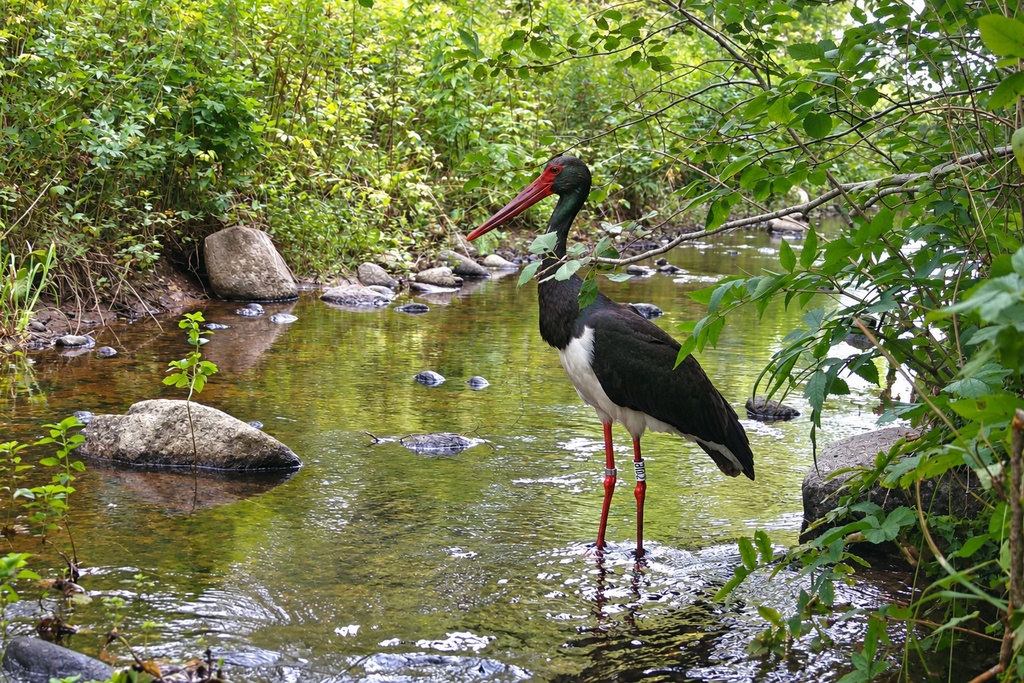
The black stork is native to Estonia, but has become so rare that only 30–40 pairs are thought to be breeding in the entire country. Less than ten nests with chicks are known.
This year, a male bird was observed feasting on fish in the streams of Southern Pärnumaa. It was named Looder and was fitted with a GPS-GSM transmitter.
Despite his name, Looder proved to be quite a diligent guide. His movements showed which streams and rivers black storks use for feeding in Southern Pärnu County, and led experts to a previously unknown nest in Latvia, a few kilometers from the Estonian border, where three chicks were raised.
Based on the knowledge gathered, the organization of Rail Baltica construction work in Estonia is now being changed to minimize disturbance to the birds in the most important black stork feeding grounds.
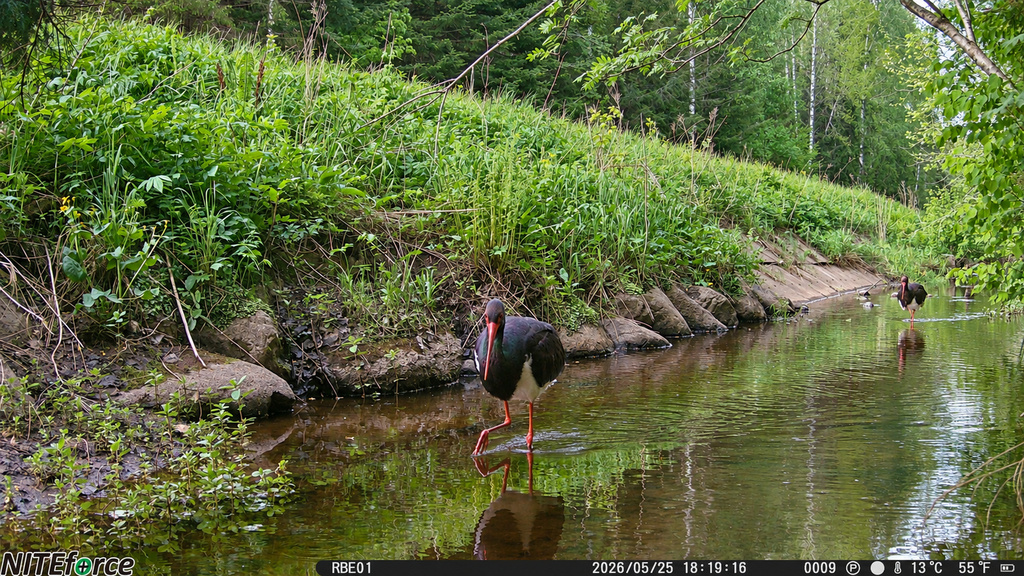
The value of the streams in southern Pärnu County was revealed thanks to trail cameras installed by Rail Baltic Estonia. In one case, they recorded three unringed black storks feeding at the same time. Knowing that only a few dozen pairs of this species breed in Estonia and that young vagrants do not end up here every day, the fact that three birds were caught in one frame is an event that surprised even species experts.
From April to the end of August, the rivers and streams of Southern Pärnumaa were monitored with a total of 12 trail cameras.
They proved to be successful monitoring tools as impartial nature reporters. In addition to the black storks, 18 bird and 14 mammal species were recorded, including several protected species. For example, an otter could be seen greedily eating river snails; a wolf, with a roe deer's hind leg in its teeth, crossing a stream; and a bear enjoying relaxing water treatments in the river.
Rail Baltic Estonia environmental experts Triin Leetmaa and Tanika Sandberg, however, focused on the black stork.
They waded in rivers and streams, looking for footprints indicating the presence of birds, and placed trail cameras in shallow water sections suitable for feeding by the cranes. By autumn, 64 bird tracks were obtained from at least six different birds, including a male ringed in Latvia in 2014 and a chick hatched in eastern Estonia in 2024.
Gradually, a pattern began to emerge on the map, helping to identify where the black storks spend their days.
The black stork is a category I species and is critically endangered in Estonia.
Its numbers have declined sharply over the past 35 years. One reason is a shortage of food: if there are not enough fish and amphibians near the nest, the bird has to make increasingly longer foraging trips, which consumes energy, which is especially needed for raising chicks and later for migration.
Therefore, protecting the black stork is not enough just to preserve its nesting sites.
Birds' feeding grounds can be tens of kilometers away from their nests. They usually search for food within a radius of up to 20 kilometers, but in case of food shortages they can travel as far as 40 kilometers. This means that even a bird nesting several kilometers away from the railway may go to feed every day in a small stream near the route.
Four previously known black stork habitats near the Pärnu-Estonia-Latvia border section of Rail Baltica are currently uninhabited, but this does not mean that the area is empty of black storks. The water bodies around the route are used for feeding by birds from at least two active breeding territories. One of them did not have chicks this year, but in another nest found as a result of Rail Baltic Estonia monitoring, three chicks were able to fly.
Trail cameras revealed that important feeding areas for these pairs include Arumetsa Stream, Häädemeeste River, Kivioja, Lemmejõgi, Loode Stream, Priivitsa Stream, Rannametsa River, Timmkanal and Ura River. All of them have calm sections with low water where the storks can go for food. They like to walk along the water while fishing.
In June, additional feeding places for black storks were installed in three streams in Häädemeeste rural municipality.
Small fish 5–10 centimeters long were placed in fish cages placed in shallow water, and trail cameras monitored both the arrival of black storks and when the food supply needed replenishment.
The purpose of the additional feeding was to supplement the food supply of the black storks moving in the area and, if possible, to catch them to equip them with GPS transmitters. The black storks started visiting one of the three additional feeding sites. “During the summer, 2610 fish were brought there, and the cage was filled 19 times in total,” said Rail Baltic Estonia’s environmental expert Triin Leetmaa. “The black stork went to eat almost every day, mostly once or twice a day. On the busiest day, however, as many as eight times. The feeding behavior of most birds is affected by the weather. So was the black stork: in rainy weather or when the water level was high, the feeding place remained empty.”
It was also noteworthy that at the same time, the number of black stork sightings decreased in other sections of the stream that were previously regularly visited. This suggests that the additional feeding affected the birds' feeding behavior. This is important knowledge for environmental experts: additional feeding can support the birds during a difficult period, but at the same time, care must be taken to ensure that the man-made feeding site does not become an eco-trap for them, meaning that they do not become overly dependent on additional feeding.
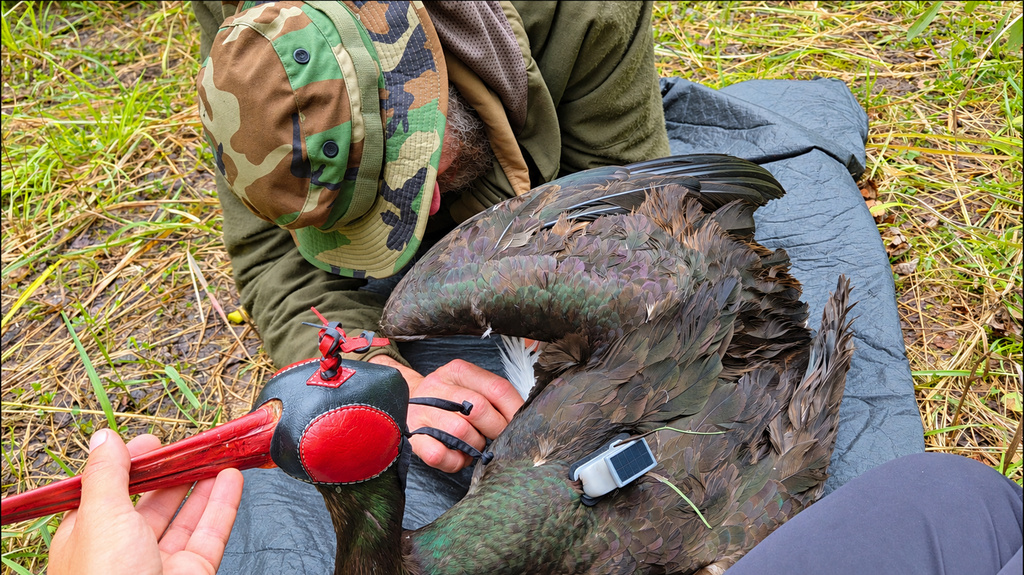
The black stork, which has become the main visitor to the additional feeding area, was fitted with a GPS transmitter in collaboration with Urmas Tellise from the Eagle Club, and its migration routes can be viewed by anyone on the migration map managed by the Eagle Club (https://birdmap.5dvision.ee).
The solar-powered device records the bird's location every 5–30 minutes and also collects data on its speed, altitude and condition. For example, if the transmitter were to remain in an unnatural position and its temperature equalizes with the ambient air temperature, the bird may have died. The GPS transmitter thus provides an accurate picture of the black stork's movements, which is not possible to obtain through mere random observations.
The stork is not the first black stork in the region to be equipped with a GPS transmitter.
In 2020–2024, data on the male bird Timmu was collected in the same way. Unfortunately, Timmu died during the spring migration of 2024, but we do not know how. Over the past 20 years, over 50 black storks have been equipped with GPS transmitters in Estonia, many of whom, like Timmu, have become lost during migration. On those rare occasions when the cause of death of a bird is known, the cause has been flying into power lines or electrocution on uninsulated poles, and repeatedly shooting on the migration route or in wintering areas. In addition to adult birds, GPS transmitters are also placed on chicks, only a few of which have survived their first migration. If the chicks are in poor condition due to lack of food, there is a high probability that they will weaken from exertion or fall prey to a predator or bird, often with human intervention. Of the two black stork chicks that received a GPS transmitter in Estonia this year, one was shot by poachers in Moldova, and the remains of the other were found near an old fish farm in Belarus, where poaching is also suspected.
Timmu's four-year data collection is still available and, together with Loodri's more recent movements, helps us understand which places remain important for black storks over the years. The movement data of the two birds particularly clearly show the Loode stream, Priivitsa stream, Rannametsa river, Timmkanal and Ura river. The trail cameras had independently reached the same water bodies - two very different methods thus confirmed each other's results. At the same time, they also left an intriguing question open. Who are these black storks that we see with trail cameras in places where companion birds do not go? Where are their nesting sites?
However, the loggerhead's transmitter provided another important result. Until the transmitter was installed, it was not known where its nest was located.
It could only be assumed that it would be 5-10 km away from its preferred feeding grounds. However, GPS data led experts across the border to Latvia, where a black stork's nest with three chicks was found.
Rail Baltic Estonia's environmental monitoring shows well why nature conservation cannot always be based on gut feelings. The Kabli–Massiaru road runs next to the Priivitsa stream, which is frequented by black storks, and is used a lot by locals. One might think that the increased traffic would make it a bad feeding ground for black storks due to the disturbance. In fact, the birds use the stream regardless. It can be assumed that the deep bed of the stream provides the birds with enough shelter and over time they have become accustomed to the traffic.
On the other hand, there are quiet forest roads next to the Northwest Stream and Timmkanal, where there are usually very few cars. This is where unexpected construction traffic can be more problematic: black storks are not used to machinery and sometimes move on the road.
“Monitoring the feeding grounds of the black stork is a good example of what working with fine-tuning environmental measures means for the construction project of the century. The goal is not to draw the largest possible red area on the map and say that nothing can be done here. We need to know where, when and what activities actually disturb the bird and adjust the construction activities accordingly,” explained Tanika Sandberg, the lead environmental expert at Rail Baltic Estonia. “Therefore, for example, it is planned that part of the Timmkanal road will not be used for construction-related traffic from April 1 to August 31. The transport route plan on Kiviaru road along the Loode stream will also need to be reviewed during the sensitive spring-summer period to avoid movement of machinery there.”
The monitoring of the black stork does not end there. In 2027, monitoring of both known habitats and feeding areas will continue. Field observations and analysis of GPS data will be added to the trail cameras, and special attention will be paid to areas where black storks were seen on trail cameras this year, but where Loodri's passages do not reach. It is also recommended to continue supplementing feeding, especially with future construction work in mind, when more people and construction machinery will be moving in the area.
For Estonian nature, the biggest win of this work is broader than just finding a nest. In addition to the knowledge needed to organize the construction of Rail Baltica more wisely, significantly more is known about the feeding grounds of the black stork in Southern Pärnu County.
The article was first published in Õhtuleht's Content Marketing in October 2026.