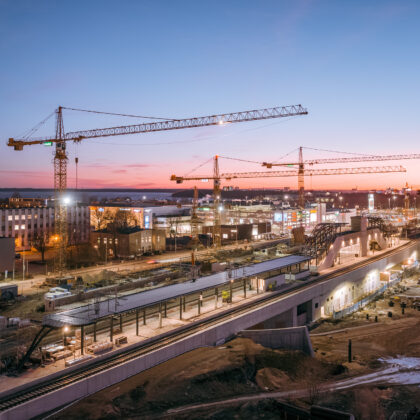


The new Rail Baltica station building was completed in the center of Riga, which is an important step towards the completion of the new station in 2028.
The passenger platforms and the square in front of the station are mostly completed along with the building, with minor finishing and landscaping work continuing until the end of the year. The next stage of construction will involve installing sleepers, rails, a control system and building out a catenary – however, the new station will not begin serving passengers until 2028.
Riga Central Station is being built in two parts to ensure that the construction of the city's main railway station does not disrupt train traffic. The old northern part of the station currently serves passengers, while a new southern part of the station was built next to it. The new station will be put into operation before Rail Baltica is fully completed: first, it will serve trains running on the existing Latvian railway network, and later, the 1435 mm European gauge Rail Baltica will be added.
The currently completed phase includes the station building itself: the roof and facade, passenger service rooms and access points, technical systems and three new platforms with canopies are complete. The public square in front of the station is also complete. Minor finishing and landscaping work will continue until the end of the year.
Guntis Āboltiņš-Āboliņš, CEO of the BERERIX consortium, said the company is ahead of schedule with these works.
"BERERIX has four more months, until the end of this year, to complete minor landscaping and finishing works in the building, public square and platforms. We are already well ahead of schedule and I have no doubt that we will finish the work on time and that even the currently unknown autumn and winter weather conditions will not affect our progress."

The next important stage is to transform the new building into a functioning railway station. Approximately six kilometres of railway line will need to be laid to bring the southern part of the station into service. The new platforms are currently scheduled to be put into service in mid-2028.
"Our railway infrastructure is still being completed. Until 2028, we have separate work on railway systems, especially control systems. This work still needs to be done," said Anita Rūdule-Jansone, project manager for Riga Central Station.
Currently, infrastructure with a track gauge of 1520 millimeters is being built there, which will allow some of the existing train traffic to be redirected to the new platforms in 2028. In the final solution, the southern part of the station will contain both the 1435-millimeter Rail Baltica tracks and the existing railway network.
"We can already see today what the station, platforms and additional spaces will look like when trains start arriving here in 2028 – even before Rail Baltica is fully implemented," said Dāvis Blaus, member of the board of Eiropas Dzelzceļa līnijas.
According to Āboltiņš-Āboliņš, the currently completed station building will only gain its true value together with the rest of the railway infrastructure. “Today we are handing over infrastructure, the full functioning of which also depends on the completion of other parts of the project, such as the railways. This infrastructure will gain its true value not when we finish building its individual parts, but when they start functioning together,” said Guntis Āboltiņš-Āboliņš.
Currently, the old northern part of the station will also continue to serve passengers. Due to lack of funds, its thorough reconstruction is not planned in the near future, and the existing tracks and platforms will be kept usable. From 2028, trains should therefore use both the old northern and the new southern parts, at least initially.
The currently completed station building phase was financed by the European Recovery and Resilience Facility and co-financing from the Latvian state. The total amount of the financing agreement is approximately 138,7 million euros, of which 114,6 million euros comes from the European Recovery and Resilience Facility and 24,1 million from the Latvian state budget.
However, several sources of European Union funding are being used to get the entire Riga Central Station up and running. According to Andulis Židkovs, State Secretary of the Latvian Ministry of Transport, in addition to the Recovery and Resilience Facility, the Connecting Europe Facility (CEF) and the Cohesion Fund will be used.