

When people in Estonia talk about the current economic impact of Rail Baltica, they usually mean the builders.
However, Kaspar Nisu, the manager of the Hepa gas station chain that grew out of Raplamaa, believes that the biggest winners of the project may instead be companies that do not build the railway, but use its completion to accelerate their next investment.
"If someone thinks that it is not worth investing in small towns, I recommend following what Grossi Toidukaubad and Coop are doing and studying their financial results," says Kaspar Nisu, member of the board of Hepa.

This is not a random comparison. Like these retail chains, Hepa also sees great potential outside of big cities.
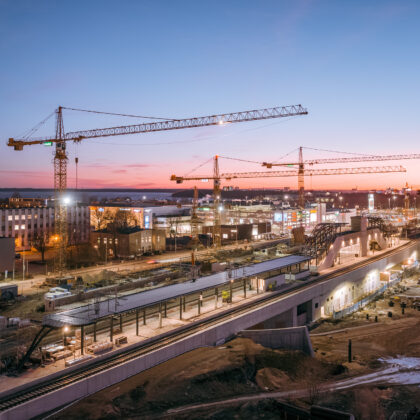
The company started more than thirty years ago with one fuel truck. Today, it has grown into a company with 12 filling stations and nearly 50 employees. Six of the filling stations are located in the immediate vicinity of the Rail Baltica route. When the company jokingly says that Hepa has become a “Rail Baltica-side filling station chain,” it reflects the change that the company has seen in its daily work in recent years.
This change and impact is not limited to refueling.
When you arrive at the Hepa gas station early in the morning, there’s more than just a coffee machine waiting behind the counter. Just before the first customers arrive, many of whom are heading to work on the construction site, fresh bread from local bakers also arrives. This is not a detail that is usually thought of when talking about billion-euro infrastructure projects. Yet it is in such everyday connections that Nisu sees the real impact of Rail Baltica. When more people stop at the gas station, more work also comes to those companies that have nothing to do with building the railway.
According to Nisu, Rail Baltica did not drive the company's investment decision. However, it did change the timing of the decision: "The railway construction was not the reason for our investment decision, but the catalyst."
For example, Järvakandi was part of Hepa's expansion plans even before the construction of Rail Baltica gained momentum in the region. According to him, the filling station would have been built even without the railway: "We would have made these investments even without Rail Baltica, but later."
It is this “later” that is most important. The infrastructure construction did not create a new business plan. It made the future secure enough for the local company to make bigger investments and faster. Today, a Hepa gas station, super-fast chargers for electric cars are operating in Järvakandi, and a laundromat is being built. As a next step, the company wants to open a gas station store.
According to Nisu, this does not only concern one company.
"In my opinion, Rapla County is characterized by a stably developing economic environment as a whole. The construction of Rail Baltica has brought large additional investments to the entire region and is thus having a positive impact on the well-being of companies. Everyone has a job and the economy is working."
He believes this will create a chain reaction. As more investment is made in the region, demand will increase: “Therefore, demand has also increased for the better services that Hepa offers its customers on a daily basis.”
The company has consciously tried to take advantage of this. The customer base has also changed.
"The construction of Rail Baltica has brought many customers to our filling stations from more remote regions of Estonia who otherwise probably would not have made it to Hepa," notes Nisu.
This means that construction is already bringing new people to the company today. However, Nisu believes that the more significant impact is yet to come: “We believe that infrastructure development will bring additional investments to the region, and why shouldn’t the industry in Järvakand make a serious leap forward in development over the next ten years.”
The biggest problem in smaller towns in Estonia is often considered to be the lack of labor. According to him, Hepa's experience says otherwise. "In fact, it's quite the opposite. In a small town, the role of an employer is easier. People are more conscientious, loyal, and appreciate the opportunity to work in their hometown," Nisu shares his experience.
If you ask him what he would recommend to an entrepreneur whose home town is being targeted by the next major infrastructure project, he doesn't start talking about subsidies and measures. "I would encourage you to invest in the same area. Take advantage of the fact that national regional policy has brought infrastructure investments to your region and nowhere else," Nisu advises.
The article was first published in Õhtuleht's Content Marketing in July 2026.